
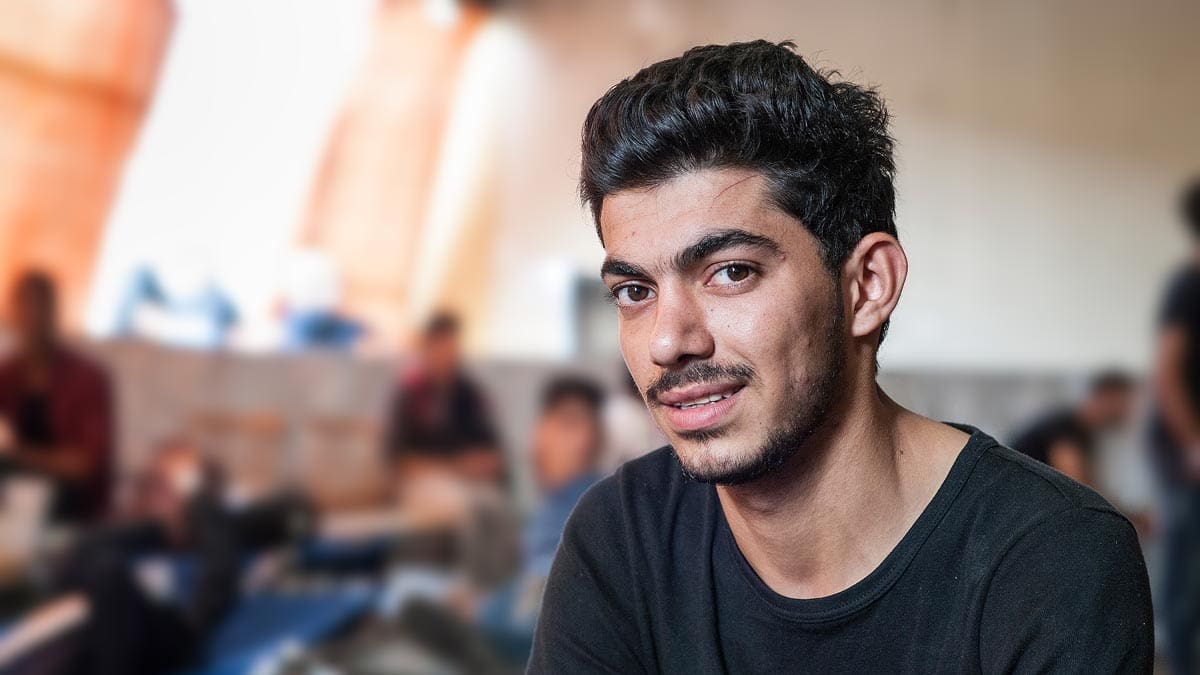
Enriched by the Farsi community
Holy Innocents was a founding member of the affirming Catholicism movement. It has a long history of social justice and is grounded in a philosophy of ‘Contemplation and Action’. The Church has been involved in campaigning for social justice as well as actively helping people in need. This led to working with asylum seekers and refugees.
It was only about five years ago that a trickle of Iranian asylum seekers coming to Holy Innocents became a stream. A few people had been housed in Home Office accommodation at the back of the Church and it was through their positive experience that they then told others. What followed was the infusion of new members into the church who, with many now having been granted the right to remain, have settled in the area.
We are not simply a multi-cultural congregation; we are also rooted in place. There is an Iranian language Church in south Manchester, and some Farsi members have tried it or were aware of it, but they chose to come to us instead. These are people working with their new identities as both Iranian and British with all its complexity. It is much more than just being multi-cultural, it is also rooted in the cultures of Anglicanism and living in Manchester. Teasing out how that blend works is an ongoing conversation.
We feel that what our Farsi members have brought to the Church has been a huge blessing, very rewarding and has had a positive impact.
Holy Innocents has been enriched by the presence of Farsi. It has deepened our opportunities for mission and welcoming everyone.
What we have learned
Our Farsi members hold a mirror up to us which is quite revealing. They tell us that we English are obsessed with words, ideas, and books. They are all different, but for some of them, their encounter with faith and with God is less ‘in the head’ than we hold to. What they have given is perhaps a glimpse of a much more ancient encounter with Christian faith. It is not intuitive through the words we use, but through the way everyone behaves, our relationships with one another, picking up on the atmosphere between us, feeling a sense of peace, a sense of welcome and unconditionality. Suddenly, all the words become irrelevant and what is happening is experiential. This has inspired us to think about the need to understand different ways of connecting and praying which are much less attached to the words. It also highlights that when we are doing things on behalf of someone else, we should make as few assumptions as possible. To make the Church accessible, we need to ask, engage, and take risks.
With different groups worshipping together at Holy Innocents, it is without doubt an inclusive Church. What this has done is to train a spotlight on the meaning of ‘inclusion’. Inclusion is more than one group (with power and space) inviting others (without power and space) to join it – it is a process of sharing that power and space, to the point where all are inviting all. This is a process we are only at the start of.

What we are doing
As we mature further, we need to think about how we organise ourselves and not just live as a Church community. We are becoming a community, but the organisational structures and leadership are yet little altered, and that will change.
Although we didn’t plan the journey, it is worth taking. Most importantly, anyone walking into church, brings Christ with them.
We are at the early stages of identifying the challenges and problems to becoming organised, the most important is unravelling the needs and expectations of different people. We remain mindful not to generalise; our Farsi members are as different from one another as we are. They come with different presumptions, styles, and ways of engaging with others. The only similarity as a group is that they have grown up in Iran and, as such, have not been steeped in Anglican religion.
One of the challenges we talk about and continue to wrestle with is in simple practical ways. For example, we have a very fixed liturgy using ‘words’, what you might call a modern Catholic liturgy, that can be difficult to understand for those whose English isn’t good. Using simple language wherever we can does help. In fact, the repetition and familiarity offers a way into the liturgy because it’s the same every week. In finding ways to make services accessible, we ask ourselves: which parts do we maintain, and which parts do we adapt? And that is a much more subtle series of questions than simply uprooting ourselves from tradition to become multi-cultural.
Music is another example of a practical challenge. Many Farsi members associate their newfound faith with classical musical grammar, which is quite widespread and familiar in Iranian culture as it sits alongside Arabic musical grammar. We are currently thinking about whether to have some songs in Farsi, or use a different musical intonation.
The way that we organise ourselves is steeped in Anglican tradition. We need to review and adapt the way we work because it’s not all about inviting people to join our structures, it is perhaps that our structures need to change. The question we are asking ourselves is: How do we craft services that remain firmly Anglican and Anglo-Catholic but are also accessible, meet people’s needs, and support their prayer? Also, how do we organise ourselves to include ‘everyone’. We do have some Farsi members on the PCC who are starting to show leadership but it’s very early days.
A practical difficulty is that when they get their permission to remain, they go from euphoria to realisation that they need to rebuild many elements of their outward life. Working within the traditional structures may not be practicable or appropriate.
Richard Young, Rector of Holy Innocents, was speaking to Church for Everyone’s Gill Green in February 2022.