Test
LEAD: Stewart Rapley
Stewart is on the autistic spectrum and has an MA in Theology which explores the impact of autism on the concept of God. His book on faith and autism will be published in 2020.
Also on this page: FAQ | Further information
Where we are now
It is estimated that at least 1 in 100 people in the UK are ‘on the autistic spectrum’ – with several times this number involved through direct association and involvement. It is likely that most congregations will contain people ‘on the spectrum’ or involved with someone who is.
Stewart’s research on autistic cognition and its impact on issues of faith and church engagement is guiding the development of practical ideas for improving this engagement.
We are starting with some initial ideas, a ‘starter’ list of interested participants from around the UK and a conviction that churches have much to offer and receive from autistic worshippers.
What we have learned
The institutional church has historically propagated unhelpful theological understandings of ‘difference’, often presuming a remedy based on repentance and change, healing or exorcism.
Many churches are recognising that there are those in their congregations for whom the sense of ‘difference’ has become a barrier to engagement. They are reaching out, seeking to provide a sense of welcome and belonging. Now that St James and Emmanuel is on this journey, there is a significant opportunity to build an understanding of how to welcome and engage with autistic worshippers.
What we plan to do
We are establishing a community, with UK-wide participation, that will invite autistic worshippers to exchange in conversation with one another about how to address the areas in which they feel ‘out of step’ with their churches and congregations.
This will have three themes:
Educating: Resources to build understanding for ourselves and for our churches in what it means to be an autistic worshipper and to welcome them.
Equipping: A forum for conversation and learning on topics such as concept of God, understanding of the Bible, approach to prayer and participation in supporting texts (creeds, liturgies, hymns and the like).
Enabling: A resource library of useful materials that we can make available to help everyone grow and develop.
Frequently asked questions
If you are autistic, does that mean that you take the Bible literally?
Not necessarily. The tendency is certainly there and some no doubt will. Others may well have developed sufficient self-knowledge, or have sufficient background education on relevant topics, so as to recognise not only the literal sense of the words but also the fact that such a literal reading would be unhelpful or inappropriate in this case.
Don’t neurotypical people (people who are not on the autistic spectrum) have many of the same issues as autistic people when it comes to interpreting the Bible (for example, how literally to take things)?
Yes, quite often. The difference comes mostly in the impact that such issues have. Autistic people are quite inclined to become obsessed by issues that ‘don’t make sense’ to them and, finding no way to resolve an issue, to be severely affected by the resulting cognitive dissonance – for example being, quite literally, ‘kept awake at night’ . Neurotypical people tend to have more options available to them in terms of mitigating such impacts – often relating to inferences from context (either biblical or their own experience). This means that, whilst they notice the same issues they are less troubled by them than their autistic counterparts.
Are you autistic? You don’t look it!
The traditional way of identifying autism with specific behaviours is not particularly helpful. Autism is a neurological distinctive. It affects the way in which a person processes things of a sensory and cognitive nature. This distinctive ‘processing’ can then sometimes lead to distinctive behaviours, either in terms of social differences (which result from different ‘reading’ of communication and context) or in a more reactive way in response to the distress of an ‘overload’ situation. Autistic people vary in the extent to which they can develop and deploy ‘rules’ which enable them, at least in many of their day-to-day activities, to function in what society would regard as a ’normal’ fashion. It is only when they are moved outside of this ‘comfort zone’ that the extent of their difficulty becomes visible.
If you are autistic, does that mean that you don’t like people or are not sociable?
No, this is a gross generalisation. It is much more helpful to recognise that managing social interactions, especially in a large group setting, involves processing a vast amount of information. It is said that only 7% of any communication is made up from the actual words said. Autistic people tend to focus on this 7% and to experience much of the remaining 93% as ‘noise’. This makes social situations both difficult and tiring for autistic people – the more so as the size of group increases. Whilst it is probably fair to say that autistic people can often tend towards being somewhat introverted, and their social skills can often not be good, this is not the same as saying that they don’t like people.
What are the things that autistic people find hardest about church?
Autistic people are individuals and this will vary from person to person. Some things are somewhat more obvious: the unstructured ‘coffee after church’ session or too much light or sound can all cause information/sensory overload which is difficult to handle. Expectations of ’sharing the peace’ with people in the middle of a service might also be difficult for some. For others the impact might be more subtle: the (perceived) nonsensical wording of a song or the difficulty in finding anyone who will take seriously the questions they have about the Bible.
What changes do autistic worshippers need the church to make?
Top of the list is better understanding of autism. A group or setting in which their ‘real problems’ with the Bible can be addressed is also on the list. Sometimes there is a need for recognition of ‘floating’, managing attendance or non-attendance in order to avoid overload, and then the recognition that they may be ‘missing out’ on many activities assumed to be those that nourish and support people.
Further information
MA Dissertation by Stewart Rapley
The impact of autistic cognitive distinctives on conception of God and interpretation of the sacred texts of the western Christian tradition: Implications for the cognitive engagement of high-functioning autistic adults within church
Being a person with autism in church
Stewart’s thoughts on Matthew 10: 40-42. This homily was part of a St James & Emmanuel recorded service on 28 June 2020 . The passage is introduced by Nick Bundock and read by Ruth Wilde, the National Coordinator for Inclusive Church .
Church training materials
Ann Memmott is the author of some guidance notes for churches on autism, including: Diocese of Oxford “Welcoming and Including Autistic People in our churches and Communities”
The inclusion of the following material does not imply any ‘approval’ or ‘theological sanction’ of the content. Only resources that are considered of appropriate quality will be posted, but this does not imply a vetting of the content for ‘correctness’.
Items will be posted because they have been found helpful by someone – usually a member of the group. They are here for you to look at and sometimes agree with and sometimes disagree with. In this way, we are able to develop our understanding through a process of challenge and growth.
Spirituality
There are lots of ‘valid’ ways to be spiritual and these are explored at rootsontheweb.com
Hermeneutics
An introduction to hermeneutics: For those mystified by the use of complicated Greek words to describe ordinary things that we all do.
Aspergers from the Inside
Visit the Aspergers from the Inside Youtube channel
Orthodox Christians who are on the spectrum
Michael R. Lado: How My Faith and Autism Activism Go Hand in Hand
Summer Kinard: Words in Season
General Interest
Brian McLaren – heretic? Note the power of pre-conceived paradigms and the reference to ‘boundary maintenance’.
Humanity’s ultimate origin: A discussion between Rowan Williams and Richard Dawkins. Note the ‘God’ that Dawkins does not believe in versus the ‘God’ that Williams does believe in.
Interesting books
Speaking Christian – Recovering the Lost Meaning of Christian Words by Marcus Borg
Autism and the Church by Grant Macaskill
Autistic Thinking – This is the title by Peter Vermeulen
Autism as Context Blindness by Peter Vermeulen
The Meaning of Jesus by NT Wright and Marcus Borg (a dialogue)
What would Jesus Deconstruct? by John Caputo
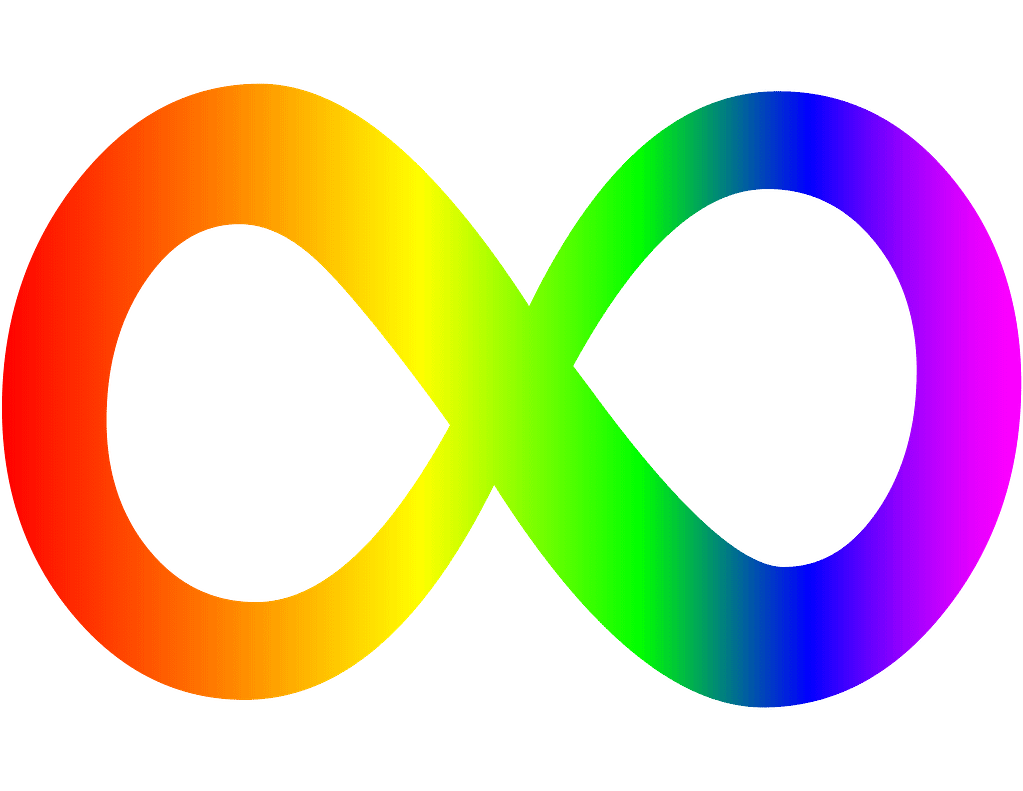
Symbol for autism
The rainbow infinity symbol is widely used to represent the diversity of the autism spectrum and the image shown is in the public domain .

Page updated: 17 August 2020